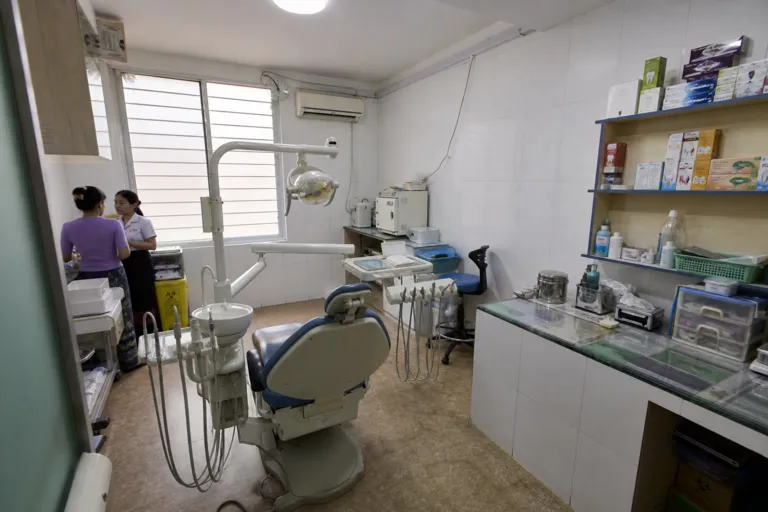
Private clinics are a defining feature of Myanmar’s dental service landscape going into 2026, and they matter because the disease burden remains high. A 2026 review reports untreated caries in 84.1% of 6-year-olds, and in over 40% of adults aged 35–44 and 65–74. The same review places the dentist-to-population ratio at approximately 1:16,000, which it describes as more than double the WHO-recommended 1:7,500. These figures frame why service access, treatment capacity, and patient willingness to pay can become central demand drivers for private clinics.
Clinic-side capacity also looks concentrated in urban, private delivery models, especially for prosthetic and restorative care. In a cross-sectional survey of dentists providing prosthodontic treatment in Myanmar, 71.9% of 367 dentists practiced in urban areas and 79.0% practiced in private clinics. The study characterizes prosthodontic services as predominantly urban-centred and privately delivered, while also highlighting structural, geographic, and economic barriers affecting equitable access. For oral care demand, this mix can support growth in clinic-linked product categories, while still leaving unmet need in harder-to-reach areas.
Where Consumer Oral Care Demand Is Showing Up in 2026
On the consumer products side, the Myanmar dental care market for toothpaste, denture cleaners, and other dentifrices is described as structurally import-dependent. One 2026 market report estimates 60–75% of supply arrives through cross-border trade and maritime imports from Thailand, China, India, and Vietnam, while domestic production covers an estimated 25–40% of volume and is concentrated in basic and herbal formulations. It projects market growth of 5–8% CAGR through 2035 and notes per-capita consumption remains well below Southeast Asian averages, which it presents as potential headroom rather than a quantified forecast of usage.
Demand signals also appear in how shoppers move across price tiers and formats. The same report estimates mass-market toothpaste dominates volume at 70–80% share, while herbal and traditional formulations capture 25–35% of value as preference shifts toward natural positioning and local ingredient narratives. It also describes premium and imported brands gaining shelf space in urban supermarkets and pharmacy chains, with price points of 3,500–8,000 MMK per 100g tube compared with 800–2,500 MMK for mass-market alternatives. Distributors are described as absorbing 10–20% cost swings tied to currency volatility and import licensing uncertainty, contributing to pricing instability.
Private clinics can influence product demand through prosthetic pathways as well. The dentifrice report describes denture cleaner demand as niche but growing at 3–6% of total dentifrice market value, linking it to an aging urban population and increasing access to dental prosthetics through private clinics. However, packaged toothpaste penetration in rural areas is estimated at 45–60%, constrained by last-mile distribution costs, low disposable incomes, and competition from traditional chewing sticks and homemade alternatives. In this context, 2026 planning often means balancing urban private-clinic demand with supply-chain realities and uneven regulatory enforcement under Myanmar’s Food and Drug Administration.
What does the 2026 evidence say about untreated caries in Myanmar?
How dominant are private clinics for prosthodontic dentists in Myanmar?
How import-dependent is Myanmar’s toothpaste and dentifrice supply?
What price range does the report cite for premium versus mass-market toothpaste in Myanmar?
What are the key 2026 signals for the Myanmar dental care market?