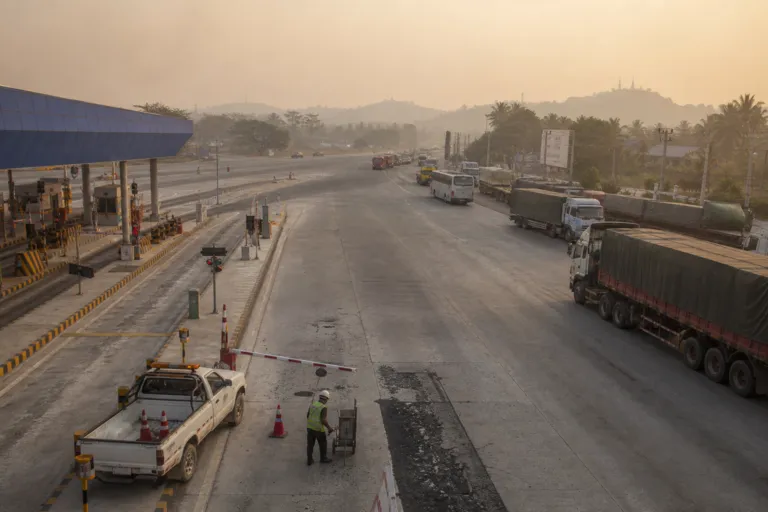
Myanmar’s road system is structured around five categories: expressways, national highways (Union Highways), main arterials, sub arterials, and Asian (ASEAN) Highways. This framework matters because road freight is central to the country’s logistics activity. In the Myanmar freight and logistics market, road freight transport captured 71.12% of freight transport segment revenue share in 2025, showing how much trade movement depends on drivable corridors rather than alternative modes. At the same time, broader logistics demand is projected to rise, with one forecast expecting the market to grow from USD 6.35 billion in 2026 to USD 7.43 billion by 2031, at a 3.21% CAGR over 2026–2031. These conditions keep attention on upgrades and new builds for national connectivity.
The expressway network is described as undergoing gradual modernization, and the Yangon–Mandalay Expressway (E 1) is its backbone. Completed in 2010, E 1 is a 590-kilometer, four-lane highway linking Yangon with Mandalay via Naypyidaw, the capital. It is also a practical spine for long-haul trips between the country’s largest city and central hub. Beyond this core route, Myanmar has outlined plans for five additional expressways, pointing to a pipeline approach rather than a single-corridor strategy. For businesses, this matters because Myanmar is positioned as a principal overland bridge between China’s Yunnan Province and the Indian Ocean, a role highlighted in logistics reporting tied to the China-Myanmar Economic Corridor.
National Highways and Corridor Logic for Trade Flows
National highways add the mesh that connects production areas, border gates, and ports. In 2021, the Ministry of Construction published a list of 50 national highways, with a grid-style numbering approach described as increasing from south to north. Older route references still help illustrate corridor intent: Highway 3 runs from Mandalay to Muse on the border with China via Lashio, while Highway 7 runs from Mandalay to Moreh on the border with India via Shwebo and Kale. Other listed corridors include Highway 4 from Meiktila to Tachileik on the border with Thailand via Taunggyi and Kengtung, and Highway 8 from Payagyi to Myeik via Moulmein, Ye, and Dawei. Together, these named routes show how the network ties internal hubs to cross-border trade points.
Project momentum is also shaped by investment signals and logistics policy initiatives. One logistics forecast notes that USD 5.6 billion worth of Chinese-backed projects were announced in 2024, and it also highlights Kyaukphyu deep-sea port valued at USD 7.3 billion as a notable project. Separate reporting adds that China was the second-largest investor in Myanmar, with a total approved investment amount of 22,065 million USD as at August 2025, and it describes a 431-kilometre railway from Muse to Mandalay to be wholly funded by China Railway Eryan Engineering Group and co-developed with Myanma Railways. On the operational side, market commentary points to the National Single Window customs platform and cross-border digitization initiatives, while another source references the ASEAN Single Window initiative shaping documentation standards for cross-border cargo.
Development priorities for Myanmar road infrastructure also sit beside on-the-ground constraints and uneven road quality. Statista data cited from MMSIS indicates the length of developed gravel roads in Myanmar reached about six thousand miles in 2022, a reminder that a large share of the network is not expressway-grade. Meanwhile, logistics reports flag political instability, foreign-exchange controls, and fragmented last-mile networks as near-term challenges that can affect corridor performance. Still, demand drivers continue to accumulate. One forecast projects courier, express, and parcel services to expand at a 4.69% CAGR between 2026–2031, while e-commerce is described as having 5.9 million users generating USD 3.80 billion in gross merchandise value. As these flows grow, the case strengthens for safer, more reliable intercity and border-link roads.
What is the main expressway in Myanmar today?
How many additional expressways has Myanmar outlined plans for?
Which highways connect Myanmar to borders with China and India?
Why does Myanmar road infrastructure matter for logistics performance?
What do the sources say about developed gravel roads in Myanmar?