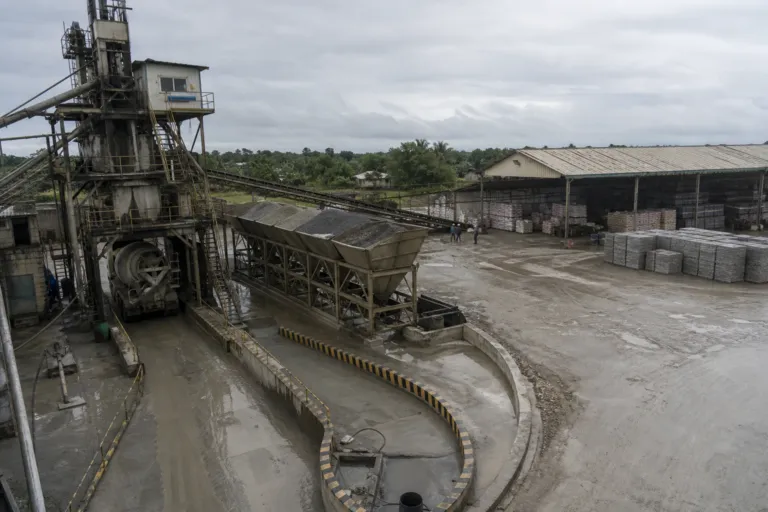
Demand signals in Myanmar’s cement sector turned more cautious in the latest reporting cycle. A 2026 market report notes that in 2025, after five years of growth, the value of Myanmar’s cement market declined by X% to $X. The same source also says consumption posted a strong increase over the period under review, with the market hitting record highs at $X in 2023 before falling slightly afterward. On the supply side, cement production in value terms contracted to $X in 2025 (estimated in export price). Production is described as having resilient growth overall, with the most prominent growth rate recorded in 2017 when production volume increased by X%, and with a value peak at $X in 2019 followed by lower levels from 2020 to 2025.
Trade patterns add more context on how local demand and regional channels may be shifting. In 2022, overseas shipments of cement from Myanmar decreased by X% to X kg, marking the second consecutive annual drop after four years of growth. Export volumes peaked at X tons in 2012, and from 2013 to 2022 they did not regain momentum. Export value also shrank significantly to $X in 2022, with the series peaking at $X in 2012. India was the main destination at X kg, accounting for approximately X% of total exports, and the average export price reached $X per ton in 2022, up by X% year over year; the report states the average price level is effectively set by prices to India because there is only one major destination.
Building Materials Market Size: What Adjacent Segments Reveal
Across other cement-linked building materials, market size trends also point to volatility rather than a straight-line expansion. In 2025, Myanmar’s market for building blocks and bricks of cement, concrete, or artificial stone decreased by X% to $X, ending a two-year rising trend. The report still characterizes consumption as showing a strong increase overall, with consumption attaining a peak level of $X before dropping rapidly in the following year. Trade in this category remained narrow: exports in 2020 were X tons, around the same as the prior year, and India was the main destination at X tons with an approximate X% share. The average export price for these blocks and bricks was $X per ton in 2020, and the report notes export prices recorded a dramatic descent compared with the 2014 peak of $X per ton.
Clinker data provides another lens on underlying cement activity because it sits upstream of finished cement. Myanmar’s cement clinker market contracted to $X in 2025, down by X% year on year, while overall consumption is described as posting a strong increase. Consumption peaked at $X in 2018, but from 2019 to 2025 remained at a lower figure. Clinker production value declined to $X in 2025, after a value peak at $X in 2018. Exports show a different pattern: after five years of growth, clinker shipments abroad decreased by X% to X tons in 2025, with export volume peaking at X tons in 2023. Thailand was the main destination at X tons with an approximate X% share, and the average clinker export price was $X per ton in 2025, up by X% against the previous year.
Downstream, ready-mixed concrete and factory made mortars show how construction demand can swing quickly. An IndexBox report states that after two years of growth, Myanmar’s market for ready-mixed concrete and factory made mortars fell by -68.5% to $862K in 2024, even though consumption is described as recording a strong expansion in general. The same report identifies Thailand as the main supplier to Myanmar in 2024, at X tons and a X% share of total imports; in value terms Thailand supplied $X, comprising X% of total imports. Alongside these segment readouts, a separate 2025 industry release states the market is to grow by 5.1% to reach $567.5 million “this year,” framing how different sources can present different snapshots of the Myanmar cement market depending on scope and methodology.
What happened to the value of Myanmar’s cement market in 2025?
Where did Myanmar’s cement exports mainly go in 2022?
How did ready-mixed concrete and mortars perform in Myanmar in 2024?
What does clinker trade suggest about regional demand for Myanmar’s output?
What are the latest reported headline figures for the Myanmar cement market?