
In 2026, Myanmar’s charging rollout sits at an early stage, but it is no longer theoretical. A market report values the country’s EV charging station market at USD 8 million in 2025 and projects it will reach USD 26 million by 2030, expanding at a 26.58% CAGR across 2026–2030. That outlook is linked to duty-free electric-vehicle import notifications, a state-led charging pilot along the Yangon-Mandalay Expressway, and rising interest in electric vehicles as a hedge against fuel shortages. The same report frames the sector as the smallest and earliest-stage in Southeast Asia, which makes the absolute numbers modest, but makes percentage growth meaningful.
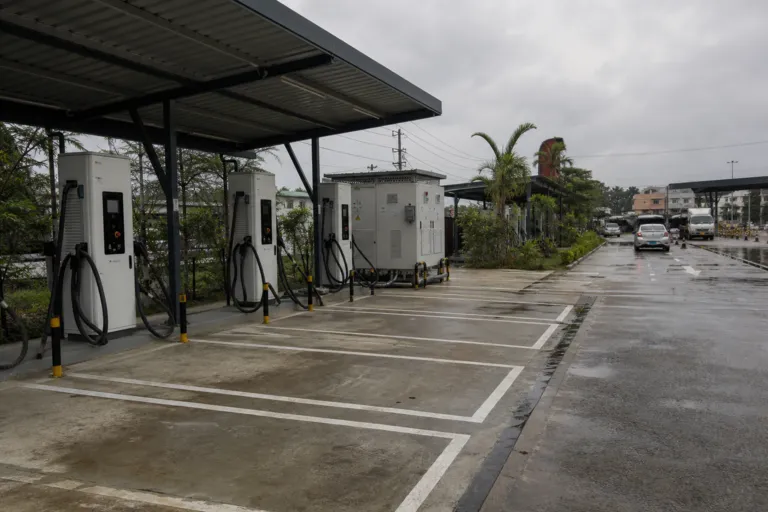
Deployment details show why location strategy matters for investors. The public network expanded from pilot sites in 2022 to a charger base near fifty to sixty units by 2025, developed under a national committee and investment incentives administered by the Directorate of Investment and Company Administration. Alternating-current chargers form about two-thirds of that base. Direct-current fast chargers concentrate in the three main cities—Yangon, Mandalay, and Naypyitaw—and along the expressway that links the commercial capital, the administrative capital, and the second-largest city. Outside this central corridor, most states and regions still have minimal charging access, which limits near-term utilization but also creates obvious whitespace for future siting.
What 2026 Vehicle Demand Means for Charging Investment
Vehicle sales data adds urgency to infrastructure planning. Myanmar’s vehicle market contracted from 8,398 units in 2021 to 3,733 units in 2023, stabilized at 4,311 units in 2024, and then jumped 189.4% to 12,474 units in 2025. In 2026 YTD through September, total sales reached 13,715 units, already exceeding the 2025 record by 9.9%. BEV/PHEV volumes are expanding at 151.7% year on year and now account for 68.2% of total industry sales, up from 49.7% a year earlier. As electrification becomes central to new sales, charger placement near high-traffic corridors and city clusters becomes a commercial necessity, not just a policy project.
Operator structure and standards are also shaping the Myanmar EV charging infrastructure market’s investment profile. Deployment is described as early-stage and state-anchored, with ministries and state electricity corporations leading, while private builders such as Yar Zar Min Industry and vehicle distributors add sites, often co-located at fuel stations. Battery-electric adoption is led by Chinese brands including MG, BYD, and Wuling, alongside a legacy Nissan fleet of a few hundred vehicles that seeded early charging demand in Yangon. The ecosystem uses a mixed set of connectors, including Chinese GB/T, CCS2 direct-current, and Type 2 alternating-current, which can influence procurement choices and interoperability planning for new entrants.
Regional and global context underscores both opportunity and scale differences. Globally, one industry report estimates the EV Charging Station Market will be valued at USD 46.80 Bn in 2026 and anticipates growth to USD 503.69 Bn by 2033, with a 40.4% CAGR. In Southeast Asia, a separate analysis cites IEA-referenced growth where charging station deployments across Indonesia, Thailand, Malaysia, and Vietnam increased ninefold between 2022 and 2024, and it projects the ASEAN EV market will grow from USD 5.99 billion in 2026 to USD 23.58 billion by 2031, a 31.55% CAGR. Against this backdrop, Myanmar’s rollout remains smaller, but the combination of a state-led expressway pilot, rapidly rising BEV/PHEV share, and a charger base approaching fifty to sixty units by 2025 creates a clear starting point for 2026 investment decisions.
What is the projected size of Myanmar’s EV charging station market by 2030?
How many public chargers are in Myanmar’s network today?
How fast are BEV and PHEV sales growing in Myanmar in 2026?
Who is leading deployment in the Myanmar EV charging infrastructure market?
Where are fast chargers mainly located in Myanmar?