Myanmar’s rare earth sector has grown into a strategically important upstream supplier for China, especially for heavy rare-earth elements. Reporting cited by Kachin News says almost all of Myanmar’s rare-earth exports go directly to China, while China controls more than 90% of global refining and processing capacity for high-value heavy rare-earth components. This structure helps explain why extraction inside Myanmar matters, but does not automatically translate into leverage for local stakeholders. The same reporting highlights constraints including political instability, fragmented governance, dependence on one dominant downstream buyer, and the absence of refinery technology and coordinated resource management.
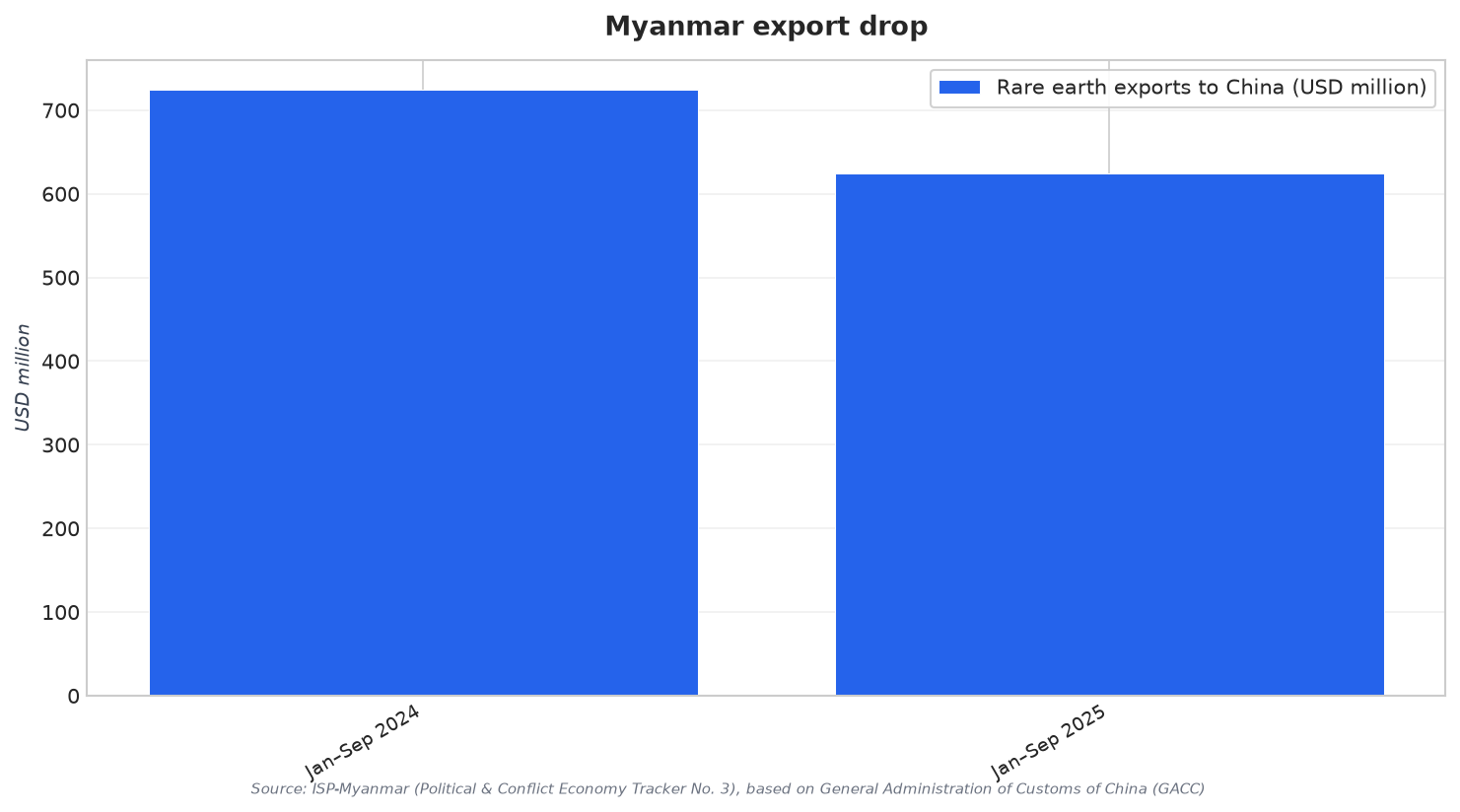
Trade and customs data underline how concentrated the export channel is. ISP-Myanmar, citing China’s General Administration of Customs (GACC), reports that in the first nine months of 2025, rare earth exports from Myanmar to China totaled USD 624 million and over 28,000 tonnes. Over the same January-to-September period, China imported more than 52,000 tonnes of rare earths in total, and 53% of that volume (over 28,000 tonnes) came from Myanmar. ISP-Myanmar also notes this was down by roughly USD 100 million and more than 10,000 tonnes compared with the same period in 2024, when Myanmar’s exports to China totaled USD 724 million.
Mining Expansion, Armed Control, and Rising Environmental Risk
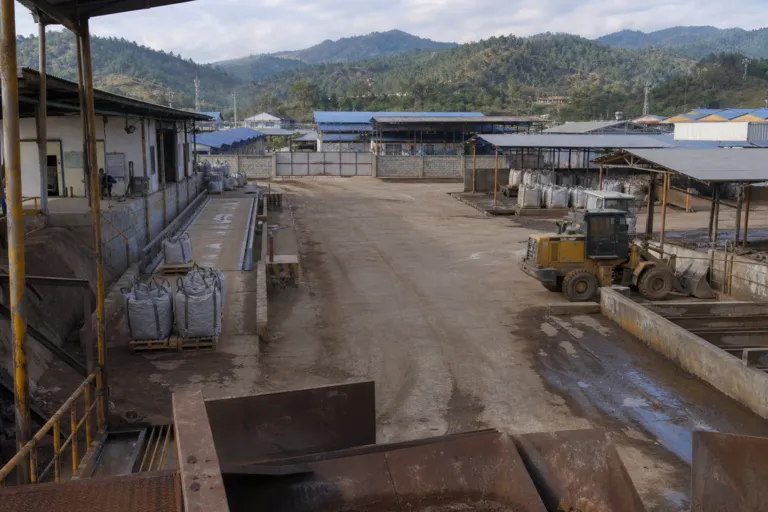
On the ground, mining is concentrated in Kachin State and is expanding into Shan State. The Lancet Regional Health – Southeast Asia reports that Myanmar yielded 22,000 tonnes of rare earth oxide equivalent in 2025, and that mining is concentrated in Kachin State—Pangwa, Chipwi, and Momauk—while expanding into Shan State where the United Wa State Army controls operations near the Chinese border. The same article states that nearly 400 mining sites operate across Kachin State alone, representing a 194% increase since the February 1, 2021 military coup, and adds that all mining is effectively unregulated, with no environmental impact assessment ever conducted for any rare earth operation in Myanmar.
Detailed site evidence reinforces the pace of expansion in key townships. ISP-Myanmar reports geospatial findings in Chipwi and Momauk showing Chipwi’s mining sites more than tripled from around 100 to 357, while in-situ leaching collection pits rose by 150% from 1,000 to over 2,500. The report also states that overall mining activity expanded by 194%, spanning 13 village tracts and covering at least 36 villages. It links this surge to conflict-affected regions, describing illegal and unregulated activity involving both military-backed entities and ethnic armed organizations, which compounds social and environmental challenges in the extraction areas.
Over time, the export record shows how Myanmar’s position has strengthened inside the cross-border supply chain that feeds China’s processing base. ISP-Myanmar says that from 2017 to 2024, Myanmar’s export value to China exceeded USD 4 billion, and that USD 3.6 billion of this was shipped during 2021–2024, accounting for 84% of the 2017–2024 total, with a peak year of USD 1.4 billion in 2023. The Lancet reports that between 2017 and 2024, Myanmar exported over 290,000 tonnes to China valued at more than USD 4.2 billion, with nearly 85% of that value generated after the February 2021 coup. Within the Myanmar rare earth market, supply growth is now also being observed beyond Kachin: ISP-Myanmar notes that at least 20 new sites were observed in UWSA-controlled Mong Yun and Mong Pawk and in NDAA-held areas of Mongyawng Township, as neighbouring countries such as Thailand move to monitor cross-border impacts.
How much did Myanmar export to China in the first nine months of 2025?
How did 2025 exports compare with the same period in 2024?
What share of China’s rare earth imports came from Myanmar in early 2025?
What does the evidence say about regulation and environmental oversight in Myanmar’s mining areas?
What is shaping the Myanmar rare earth market’s leverage with China?