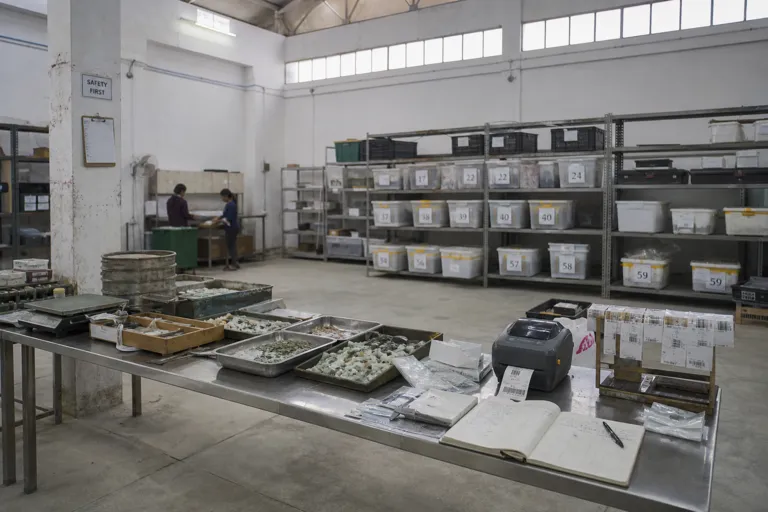
Myanmar’s role in jade supply is repeatedly highlighted across global market sources. One jadeite market forecast states that Myanmar alone contributes approximately 90% of the world’s rough jadeite output and exported over 35,000 tons in 2024. Another forecast frames the supply base slightly differently, stating that more than 75% of commercial jadeite supply originates from deposits in Myanmar, with secondary production in Guatemala, Japan, Kazakhstan, and Russia. For 2026, those supply descriptions matter because they position Myanmar as the critical upstream origin for a value chain that depends on cross-border trade, cutting, and retail demand in Asia-Pacific and beyond.
On the demand and pricing backdrop, several global market reports point to expansion through the next decade. One source values the global jadeite market at USD 5,039.65 million in 2026 and projects USD 9,004.65 million by 2035, with a 6.66% CAGR. A separate jadeite forecast estimates USD 4,992.39 million in 2026 and projects USD 9,089.21 million by 2035, at a 6.88% CAGR. For finished goods, one report puts the global jade jewelry market at USD 5.11 billion in 2026 and forecasts USD 8.77 billion by 2034, with a 6.1% CAGR. These figures are global, not Myanmar-specific, but they set the tone for why upstream jadeite origin remains strategically important.
2026 Trade Drivers: Asia-Pacific Demand, Digital Sales, and Auctions
Asia-Pacific demand is a recurring theme. A jade jewelry report describes Asia-Pacific as the most significant global holder of jade jewelry market share and notes that in China and Myanmar, jade is used as both a gemstone and an amulet. In parallel, a jadeite market forecast attributes demand from Asia-Pacific to nearly 85 million carats, driven largely by China’s retail and auction sectors. The same source adds that in 2024, over 72% of global jadeite sales were attributed to premium categories such as Type A untreated jadeite. It also reports a 34% growth in gemstone auctions specializing in jadeite items and says online jadeite sales reached over 18 million transactions globally in 2024.
Supply-chain resilience is the main swing factor for trade execution. A jade jewelry industry source says the industry is substantially dependent on imports from Myanmar and notes that border closures and lockdowns disrupted supply chains in China and Myanmar, leaving traders and workers unable to cross borders and causing scarcity in raw materials and final products. Regulatory and cost pressure is another constraint signaled for the Myanmar trade lane. One jadeite forecast states that regulatory pressure and traceability enforcement on Myanmar jadeite increased compliance costs by 33% since 2022. It also reports a 17% increase in taxation and trade compliance expenses in Myanmar in 2024, alongside a 21% surge in logistics costs due to geopolitical instability and export restrictions.
For the broader gemstone context around Myanmar, a global gemstones report says the overall market is expected to rise from USD 38.40 billion in 2026 to USD 60.42 billion by 2034, at a 5.83% CAGR, after being valued at USD 36.28 billion in 2025. In the same source, Myanmar is also described as responsible for nearly 90% of the world’s rubies of gem quality, underlining its wider role beyond jade. For the Myanmar gems and jade market outlook in 2026, the practical takeaway is clear: global demand signals remain positive, but trade outcomes hinge on border mobility, compliance capacity, and the ability to absorb higher logistics and documentation costs while serving premium, traceable demand channels.
What is the 2026 global outlook for jadeite demand?
Why does Myanmar matter so much to global jadeite supply?
Which demand channels are expanding for jadeite products?
What trade risks are most relevant to the Myanmar gems and jade market in 2026?