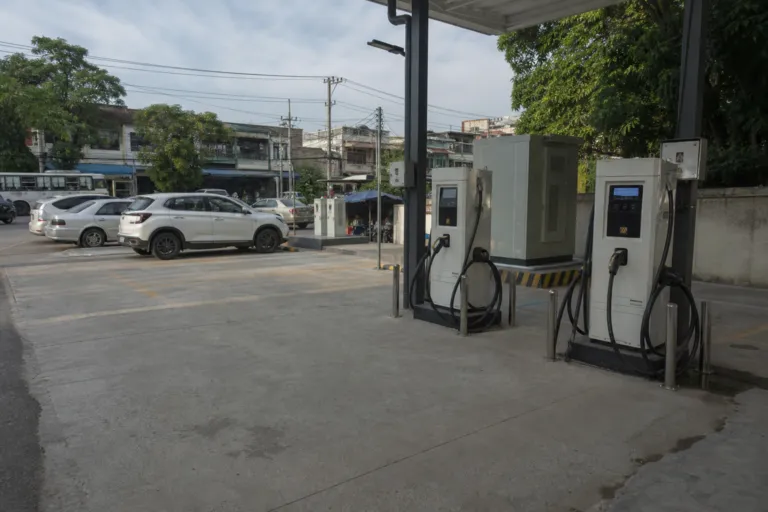
Myanmar’s electric vehicle story is moving from curiosity to measurable momentum. In the country’s EV sector, year-to-date sales rose by 228.8% up to April 2026, according to Focus2move. That growth is happening while Myanmar’s economy is projected to expand modestly, with GDP expected to increase by 2.4% in 2026 and 2.7% in 2027, and per capita GDP growth forecast at 1.7% and 2.0% respectively. The same outlook notes severe economic challenges, particularly high inflation, which means EV adoption is not only a product question. It is also a financing, operating-cost, and infrastructure question that will shape what buyers can realistically choose.
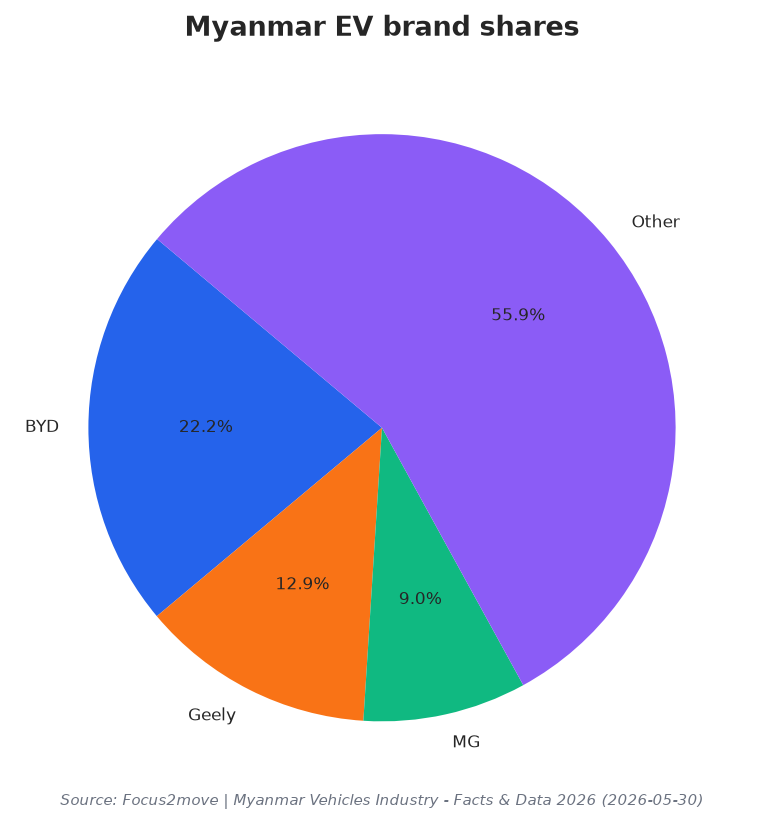
Brand and model mix shows where demand is forming. Focus2move reports BYD as the market leader with a 22.2% share, up 185.7%. Geely followed in second, up 10 spots, gaining 6725% to a 12.9% share, while MG ranked third, up 192.3%. At the model level, the Toyota bZ4X became the best seller, up 14 spots into first with a 9% share. The BYD Seagull ranked second, growing by 490.9% to a 6.2% share. Together, these shifts suggest buyers are responding to specific vehicle value propositions, and that competitive lineups are arriving quickly enough to reshuffle leadership positions within a short period.
Charging Outlook: Why Access Matters as Much as Vehicles
Charging access will likely be the make-or-break constraint as the market scales. The IEA’s Global EV Outlook 2026 highlights a global pattern: most electric car owners charge at home, and this preference is expected to remain due to affordability and convenience. Globally, private light-duty vehicle charging points are estimated to have reached more than 43 million in 2025, supporting an electric light-duty vehicle stock of around 76 million. The report also shows how housing patterns affect home charging: in Norway, where 64% of the population lives in detached or semi-detached houses, around 90% of EV owners can charge at home. In China, where only 7% of residents live in single-family houses, a 2025 survey found only around 50% of EV owners have home chargers, though another third have access to shared residential chargers.
For Myanmar, the sources point to infrastructure as a direct lever for adoption rather than a secondary issue. A Myanmar battery market analysis states that increasing awareness of environmental issues and the government’s initiatives to promote electric vehicles have led to a surge in demand for batteries used in EVs. The same source explicitly links infrastructure development to uptake, noting that investing in EV charging infrastructure can help accelerate adoption and increase battery demand. It also flags constraints that can slow momentum, including that the battery manufacturing sector in Myanmar lags behind in technological advancements, which can hinder production of high-quality batteries and affect overall market growth.
Regional context underlines how policy and charging investment can change the pace of transition, but it should be treated as comparison rather than a direct proxy for Myanmar. One Southeast Asia EV market report values the regional market at approximately USD 8.2 billion in 2025 and forecasts USD 182.4 billion by 2034, a 52.0% CAGR for 2026-2034. It also states that Thailand registered approximately 140,000 EV unit sales in 2025, and includes a claim that ASEAN-6 governments have committed over USD 3.5 billion in subsidies, exemptions, and infrastructure co-investments. Another ASEAN report estimates the ASEAN EV market at USD 7.84 billion in 2024 with a 7.2% CAGR between 2025 and 2034. For the Myanmar EV market, the takeaway is strategic: sustained adoption depends on pairing product availability with charging access that fits local housing and parking realities, while keeping affordability and reliability at the center of planning.
How fast are EV sales growing in Myanmar in 2026?
Which EV brands and models lead Myanmar’s market right now?
What does the IEA say about charging behavior and why it matters?
How does Myanmar’s battery market analysis link charging buildout to EV adoption?
What is the outlook for the Myanmar EV market when compared with Southeast Asia?