
Client
Issues
The distribution network had expanded without a clear regional structure. Warehouses carried overlapping inventory, delivery routes were planned manually, and several townships experienced frequent stock shortages despite high overall inventory levels. Management also had limited visibility into distributor performance and the true cost of serving different locations.
Solution
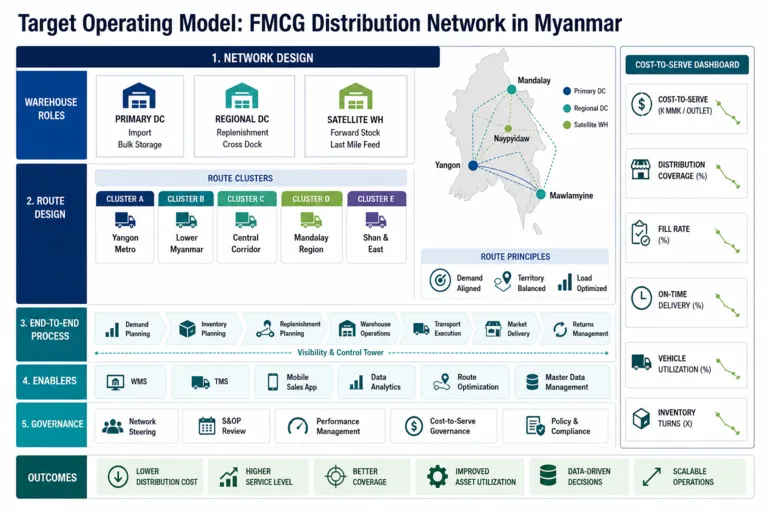
We designed a Myanmar distribution-network improvement plan covering warehouse roles, inventory allocation, route planning, distributor management, and performance monitoring. The objective was to improve product availability while reducing unnecessary stock movement and delivery activity.
Approach
We analysed order histories, warehouse inventories, delivery routes, vehicle utilisation, service frequency, and customer locations. Interviews with sales teams, distributors, warehouse staff, transport providers, and retailers helped identify recurring service issues. Several network scenarios were modelled to compare cost, coverage, inventory requirements, and delivery lead times between Yangon, Mandalay, and regional townships.
Recommendations
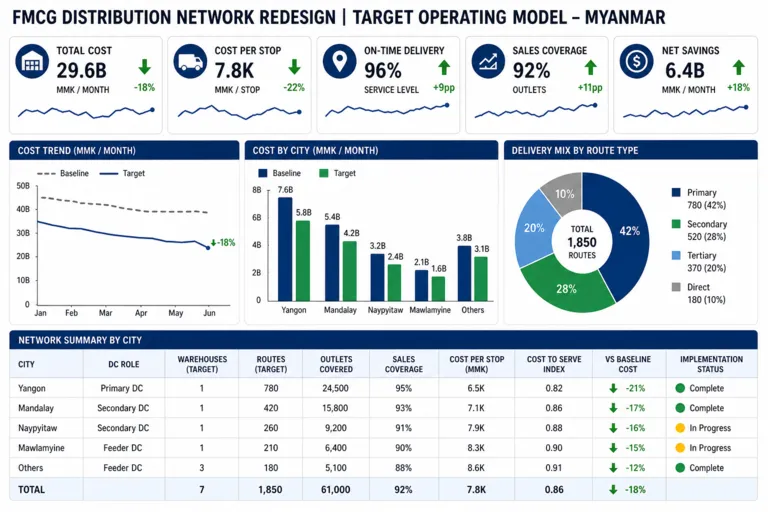
We recommended assigning clearer roles to the existing warehouses and introducing differentiated inventory policies based on product demand and location. Delivery schedules were redesigned around geographic clusters, while distributor territories and service expectations were clarified. Basic dashboards were also proposed to monitor stock availability, delivery performance, distributor execution, and cost-to-serve.
Engagement ROI
The pilot reduced average delivery distance across selected routes by approximately 8% and improved availability of priority products at participating retailers. Inventory transfers between warehouses declined, while management gained a clearer view of regional service costs. The redesigned model created a practical basis for expansion into additional Myanmar townships.