
Client
Issues
Businesses across Myanmar faced electricity interruptions and increasing dependence on diesel generation, but not every customer had the demand profile or financial capacity required for solar investment. The client needed to understand which sectors offered attractive project economics, how customers evaluated energy solutions, and which financing structures could support adoption.
Solution
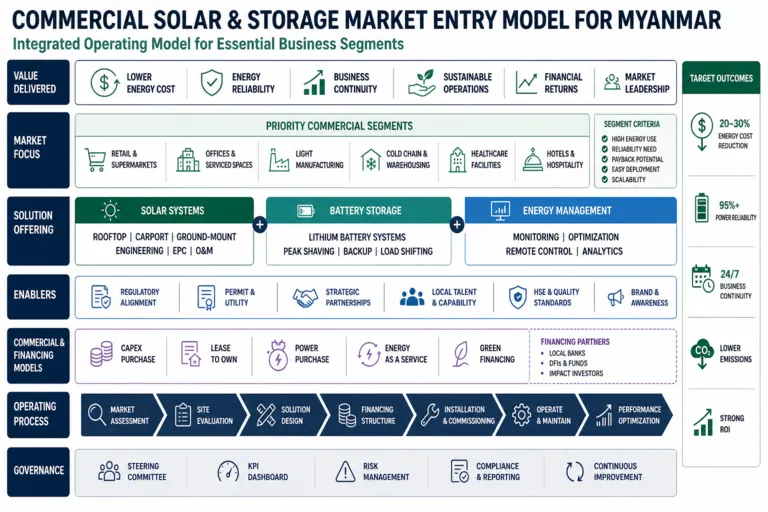
We designed a commercial market-entry strategy focused on high-priority customer segments, project feasibility, financing options, and local delivery capabilities. The proposed model combined standardised system packages with clear qualification criteria for customer sites.
Approach
We conducted interviews with factory operators, private hospitals, cold-storage businesses, hotels, energy contractors, and commercial lenders in Yangon, Mandalay, and selected industrial locations. Energy-consumption patterns and generator costs were reviewed to estimate potential savings under different system sizes. Local engineering companies were also assessed for installation, maintenance, and project-management capabilities.
Recommendations
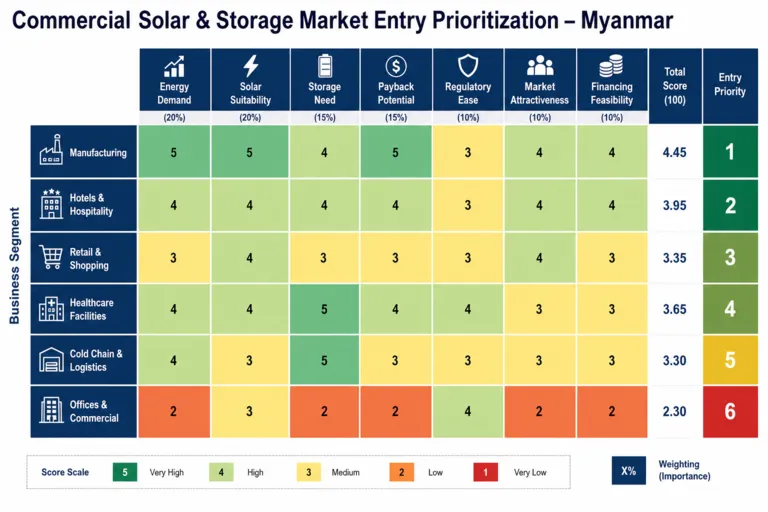
We advised the client to prioritise private healthcare facilities, food processors, cold storage, and selected light manufacturers. Standard system packages were recommended to simplify technical design and proposal development. We also proposed a combination of direct purchase and carefully controlled energy-service agreements for financially qualified customers.
Engagement ROI
The study helped the client concentrate on commercially viable opportunities rather than pursuing broad market interest. Two pilot sites advanced to technical assessment, while prospects with weak economics were removed from the pipeline. Standardised proposals also shortened the early-stage sales and evaluation process.