
Client
Issues
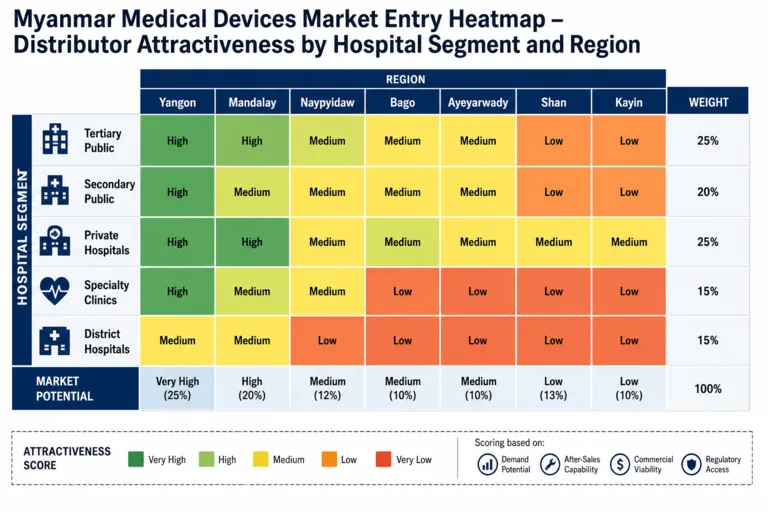
Demand existed across private hospitals, specialist clinics, diagnostic centres, and institutional buyers, particularly in Yangon and other major healthcare centres. However, procurement structures, budgets, and technical requirements varied significantly. Several distributors claimed national coverage, although their service capabilities, inventory management, and ability to support customers beyond Yangon were difficult to verify.
Solution
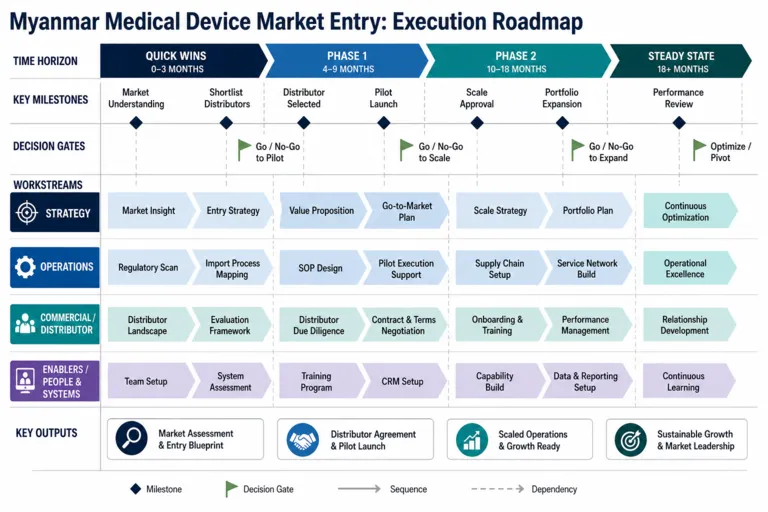
We developed a phased Myanmar market-entry strategy supported by customer research, opportunity sizing, distributor assessment, and service-network planning. The strategy prioritised products and customer segments where the client could establish a credible technical and commercial position.
Approach
We interviewed hospital managers, clinicians, biomedical engineers, procurement teams, and medical distributors. Purchasing criteria were assessed across product quality, price, training, warranty, maintenance, and availability of replacement parts. Potential distributors were then evaluated through structured commercial, operational, geographic, and technical criteria.
Recommendations
We recommended entering Myanmar with a focused range of diagnostic and monitoring products rather than the full portfolio. Two distributors were shortlisted for further negotiation, with one focused on private healthcare accounts and another supporting institutional channels. We also advised the client to retain control over technical training, warranty standards, key-account visibility, and distributor performance reviews.
Engagement ROI
The engagement gave the client a clear market-entry sequence and reduced dependence on unverified distributor claims. Commercial discussions began with a smaller group of qualified partners, while the focused portfolio simplified regulatory, inventory, and training requirements. The client gained a stronger foundation for protecting service quality during expansion across Myanmar.